Fragile X Associated Tremor Ataxia Syndrome (FXTAS)
Summary
- Late-onset neurodegenerative disorder associated with premutation in FMR1 gene
- Characterised by intention tremor, cerebellar ataxia, and cognitive decline
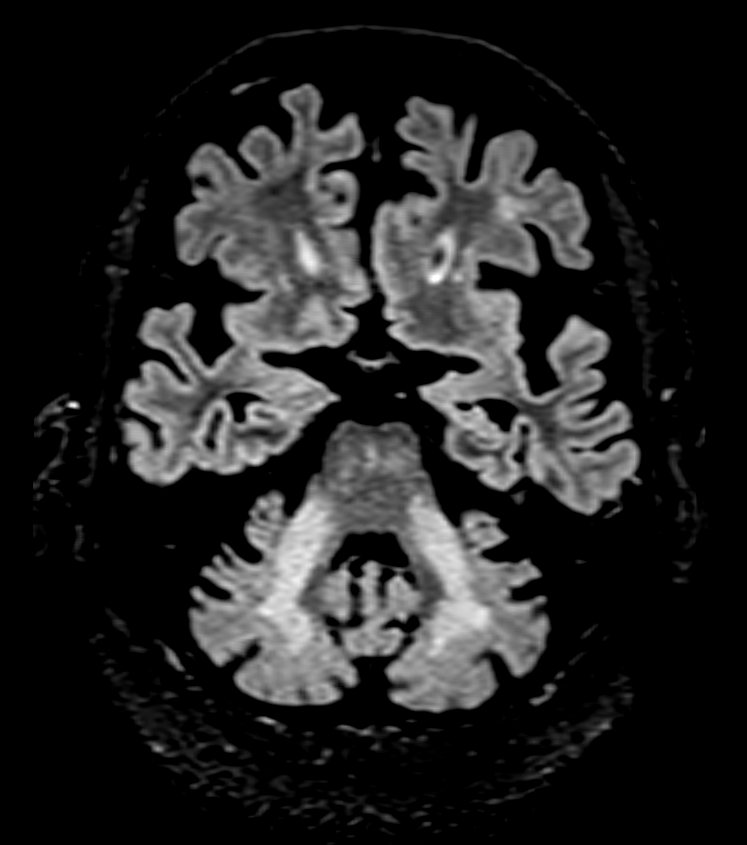
- MRI findings include T2 hyperintensities in middle cerebellar peduncles and cerebral white matter
Pathophysiology
- Caused by expanded CGG trinucleotide repeat (55-200) in 5' UTR of FMR1 gene
- RNA toxicity due to increased FMR1 mRNA levels
- Intranuclear inclusions in neurons and astrocytes
- Mitochondrial dysfunction and oxidative stress contribute to neurodegeneration
Demographics
- Primarily affects males over 50 years old
- Penetrance increases with age, reaching 75% in males by age 80
- Female carriers have lower penetrance and milder symptoms
- Prevalence estimated at 1 in 4,000 males over 55 years old
Diagnosis
- Clinical criteria:
- Major: intention tremor, cerebellar ataxia
- Minor: parkinsonism, cognitive decline, neuropathy
- Genetic testing: FMR1 CGG repeat expansion analysis
- Family history of fragile X syndrome or premature ovarian insufficiency
Imaging
- MRI findings:
- T2 hyperintensities in middle cerebellar peduncles (MCP sign)1
- Generalised cerebral and cerebellar atrophy
- Corpus callosum thinning
- Cerebral white matter T2 hyperintensities
- FDG-PET:
- Hypometabolism in cerebellum and cerebral cortex
- DTI:
- Reduced fractional anisotropy in MCP and cerebral white matter

- A 50-year-old patient, with a family history for FXTAS, presented with worsening tremor.
- MRI showed progressive hyperintensity and atrophy of the middle cerebellar peduncles.
- There was non-progressive hyperintensity within the cerebellar peduncles.
- DaTSCAN was normal and genetic testing confirmed the diagnosis of FXTAS.

- A 60-year-old patient presented with a tremor (few months) and longstanding nystagmus (many years).
- MRI showed confluent hyperintensity within the middle cerebellar peduncles and atrophy of the pons and midbrain.
- Genetic analysis confirmed the diagnosis of FXTAS.
Treatment
- Symptomatic only; genetic counselling matters as female premutation carriers risk premature ovarian insufficiency and offspring with fragile X syndrome
Differential diagnosis
| Differential Diagnosis | Distinguishing Feature |
|---|---|
| Multiple System Atrophy (MSA-C) | "Hot cross bun" sign in pons on T2; putaminal rim sign; more diffuse cerebellar and pontine atrophy |
| Spinocerebellar Ataxias | Variable cerebellar and brainstem atrophy patterns depending on subtype; may show inferior olive, pons, or caudate involvement |
| Acquired hepatocerebral degeneration | T1 hyperintensity in globus pallidus and striatum; MCP hyperintensity similar to FXTAS |
-
Leehey et al. Fragile X-associated tremor/ataxia syndrome. 2012. Handbook of clinical neurology - Open in new tab. ↩