Intradiploic Epidermoid
Summary
- Rare, benign, slow-growing lesion arising from ectodermal inclusions within the skull
- Typically asymptomatic until large enough to cause mass effect or erosion
- Characteristic imaging findings include a lytic lesion with scalloped margins and no contrast enhancement
Pathophysiology
- Originates from trapped ectodermal cells during neural tube closure in embryonic development
- Slow growth rate due to accumulation of desquamated epithelial cells and keratin debris
- May cause bone remodeling and expansion over time
Demographics
- Accounts for <1% of all intracranial tumours
- No gender predilection
- Most commonly diagnosed in adults between 20-50 years of age
- Rare in children
Diagnosis
- Often incidental finding on imaging studies
- Clinical presentation:
- Asymptomatic in early stages
- Headache, focal neurological deficits, or seizures when large enough to cause mass effect
- Differential diagnosis:
- Dermoid cyst
- Arachnoid cyst
- Hemangioma
- Fibrous dysplasia
Imaging
- Plain radiographs:
- Lytic lesion with sclerotic margins1
- "Geographic skull" appearance in advanced cases
- CT:
- Well-defined, hypodense lesion
- Scalloped margins with sclerotic borders
- No contrast enhancement
- May show calcifications in 10-25% of cases
- MRI:
- T1: Hypointense to isointense
- T2: Hyperintense
- FLAIR: Hyperintense
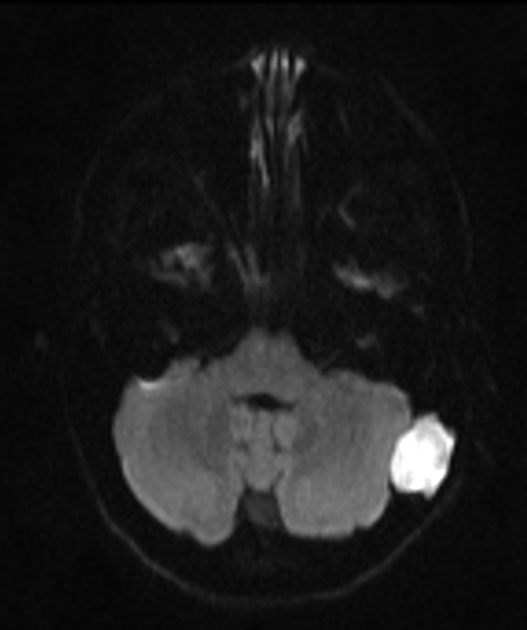
- DWI: restricted diffusion (the key feature) with incomplete FLAIR suppression
- No contrast enhancement (no fat, unlike a dermoid or lipoma)


- An incidental lesion in the left occipital bone had a narrow zone of transition on CT, low values on ADC and did not enhance on post-gadolinium imaging.

- 50-year-old patient with neck pain had a lesion identified on a plain radiograph.
- A large lesion centred on the left occipital bone projected into the posterior fossa. The smooth margins, "dirty" FLAIR signal, and diffusion restriction indicate an epidermoid cyst.
Treatment
- Observation, or complete surgical excision if enlarging/symptomatic; incomplete resection recurs
Differential diagnosis
| Differential Diagnosis | Differentiating Feature |
|---|---|
| Dermoid cyst | Contains dermal appendages like hair follicles or sebaceous glands |
| Intraosseous hemangioma | Sunburst pattern on CT, high signal on T1-weighted MRI |
| Fibrous dysplasia | Ground-glass appearance on CT, low signal on T1 and T2 MRI |
| Eosinophilic granuloma | Beveled edge appearance, more aggressive bone destruction |
| Arachnoid cyst | No restricted diffusion on DWI, follows CSF signal on all sequences |
| Meningioma | Homogeneous enhancement, dural tail sign |
| Metastasis | Multiple lesions; irregular margins; destructive bone pattern; no restricted DWI; no smooth scalloped edges |
| Giant cell tumour | Soap bubble appearance on CT; no fat or restricted DWI |
| Aneurysmal bone cyst | Fluid-fluid levels, septations, blood products on MRI |
| Cholesterol granuloma | Hyperintense on T1-weighted images due to c |
-
Miller et al. Intradiploic epidermoid of the temporal bone: case history and literature review. 1994. Otolaryngology--head and neck surgery : official journal of American Academy of Otolaryngology-Head and Neck Surgery - Open in new tab. ↩