Lhermitte-Duclos Syndrome
Summary
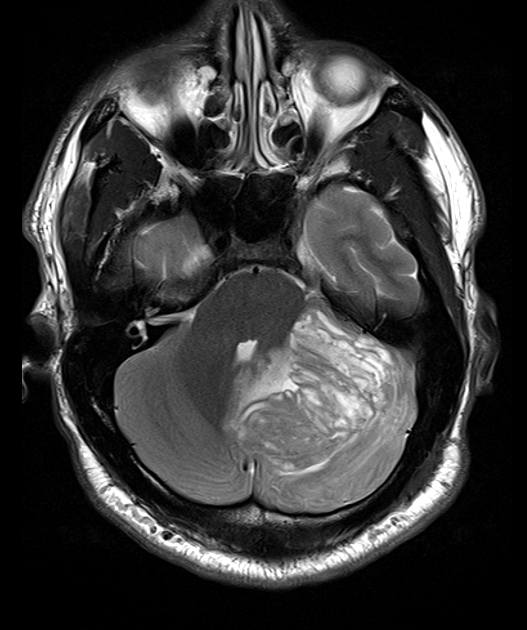
- Rare cerebellar hamartomatous disorder characterised by dysplastic gangliocytoma
- Associated with Cowden syndrome, an autosomal dominant disorder
- Imaging shows characteristic "tiger-striped" appearance on MRI
Pathophysiology
- Caused by mutations in the PTEN tumour suppressor gene
- Results in hypertrophy of cerebellar molecular layer and internal granular layer
- Abnormal arborization of Purkinje cells and increased myelination
Demographics
- Typically presents in young adults (third to fourth decade)
- No gender predilection
- Rare, with fewer than 300 cases reported in literature
Diagnosis
- Clinical presentation:
- Increased intracranial pressure
- Cerebellar signs (ataxia, dysmetria)
- Cranial nerve palsies
- Occipital headaches
- Genetic testing for PTEN mutations
- Histopathological examination of resected tissue
Imaging
- CT:
- Hypodense cerebellar mass1
- Possible calcifications
- Hydrocephalus may be present
- MRI:
- T1: Hypointense to isointense
- T2/FLAIR: Hyperintense with characteristic "tiger-striped" appearance
- Contrast: Typically non-enhancing
- DWI: Restricted diffusion
- MR Spectroscopy: Elevated lactate, decreased NAA

- An incidental expansile lesion in a 30-year-old was heterogeneously T2-hyperintense and showed tigroid (presumably vascular) enhancement.
Treatment
- Surgical resection for symptomatic/mass effect. A Lhermitte-Duclos lesion should prompt evaluation for Cowden syndrome (PTEN) and its associated cancers
Differential diagnosis
| Differential Diagnosis | Distinguishing Feature |
|---|---|
| Cerebellar hemangioblastoma | Contrast enhancement and cystic components on MRI |
| Medulloblastoma | Typically occurs in children; more aggressive growth |
| Pilocytic astrocytoma | Cystic component with enhancing mural nodule |
| Metastatic tumour | Multiple lesions, known primary cancer, rapid growth |
| Cerebellar infarction | Acute onset, vascular territory distribution |
| Posterior fossa ependymoma | Fourth ventricle involvement, calcifications |
-
Alanazi et al. Lhermitte-Duclos disease: A systematic review. 2023. Surgical neurology international - Open in new tab. ↩