Semantic Dementia
Summary
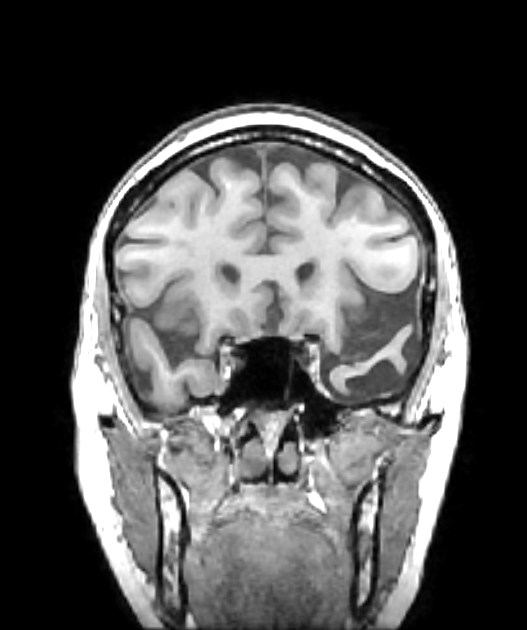
- Semantic dementia (SD) is a neurodegenerative disorder characterised by progressive loss of semantic knowledge and language comprehension
- It is a variant of frontotemporal lobar degeneration (FTLD) with predominant temporal lobe atrophy
- Imaging shows characteristic asymmetric anterior temporal lobe atrophy, typically left-sided
Pathophysiology
- SD is associated with TDP-43 pathology in most cases
- Characterised by progressive neuronal loss and gliosis in the anterior temporal lobes
- Typically asymmetric, with the left side more severely affected
- Involves the temporal pole, inferior and middle temporal gyri, and fusiform gyrus
- Relative sparing of the superior temporal gyrus and hippocampus in early stages
Demographics
- Typically presents in the 50s to 60s
- No significant gender predilection
- Rare familial cases reported, but most are sporadic
- Estimated prevalence of 1-5 per 100,000 individuals
Diagnosis
- Clinical presentation:
- Progressive loss of word meaning and object knowledge
- Fluent speech with semantic paraphasias
- Surface dyslexia and dysgraphia
- Preserved episodic memory and visuospatial skills
- Neuropsychological testing:
- Impaired semantic memory and naming
- Preserved phonology, syntax, and working memory
- Relatively intact episodic memory and visuospatial function
- Genetic testing:
- GRN and MAPT mutations in rare familial cases
Imaging
- MRI findings:
- Asymmetric anterior temporal lobe atrophy, typically left-sided1
- Progressive atrophy of the temporal pole, inferior and middle temporal gyri
- Relative sparing of the superior temporal gyrus and hippocampus
- Involvement of the fusiform gyrus and anterior insula
- FDG-PET:
- Hypometabolism in the affected anterior temporal lobe
- May show more extensive involvement than structural MRI
- SPECT:
- Decreased perfusion in the anterior temporal lobe

Treatment
- No disease-modifying therapy. The hallmark is asymmetric (usually left) anterior temporal-pole "knife-edge" atrophy, part of the frontotemporal degeneration spectrum
Differential diagnosis
| Differential Diagnosis | Distinguishing Feature |
|---|---|
| Alzheimer's Disease | Symmetric hippocampal and entorhinal cortex atrophy without anterior-to-posterior gradient; posterior parietal and precuneus hypometabolism on FDG-PET |
| Frontotemporal dementia (behavioural variant) | More symmetric frontal and anterior temporal atrophy; less pronounced asymmetric anterior temporal predominance |
| Primary Progressive Aphasia (logopenic variant) | Left posterior temporal and inferior parietal atrophy rather than anterior temporal lobe predominance |
| Autoimmune limbic encephalitis | Bilateral mesial temporal T2/FLAIR hyperintensity with swelling; may enhance; more acute onset than neurodegenerative atrophy |
-
Klimova et al. Semantic Dementia: A Mini-Review. 2018. Mini reviews in medicinal chemistry - Open in new tab. ↩