Stroke-like Migraine Attacks after Radiation Therapy (SMART)
Summary
- SMART syndrome is a rare delayed complication of cranial irradiation
- Characterised by recurrent, reversible neurological deficits and headaches
- Distinctive imaging findings include cortical enhancement and oedema
Pathophysiology
- Exact mechanism remains unclear, but proposed theories include:
- Endothelial dysfunction and blood-brain barrier disruption
- Neuronal excitotoxicity and cortical spreading depression
- Radiation-induced vascular damage and altered neurovascular coupling
Demographics
- Typically occurs in patients who have received cranial irradiation for primary or metastatic brain tumours
- Median time to onset: 20 years post-radiation (range: 1-37 years)
- No clear gender predilection
- Most commonly affects adults, but cases in children have been reported
Diagnosis
- Clinical presentation:
- Acute onset of neurological deficits (e.g., hemiparesis, aphasia, visual disturbances)
- Severe headache, often migraine-like
- Seizures in some cases
- Diagnostic criteria proposed by Black et al. (2006) :
- Remote history of cranial irradiation
- Prolonged, reversible neurological deficit
- Cortical gadolinium enhancement on MRI
- Eventual complete or partial recovery
Imaging
- MRI findings:
- Unilateral or bilateral cortical enhancement, typically gyriform pattern1
- Cortical swelling and oedema in the affected region
- Restricted diffusion may be present
- Perfusion imaging may show hyperperfusion
- CT findings:
- Often normal or may show subtle hypodensity in the affected cortex
- Follow-up imaging:
- Resolution of enhancement and oedema over weeks to months

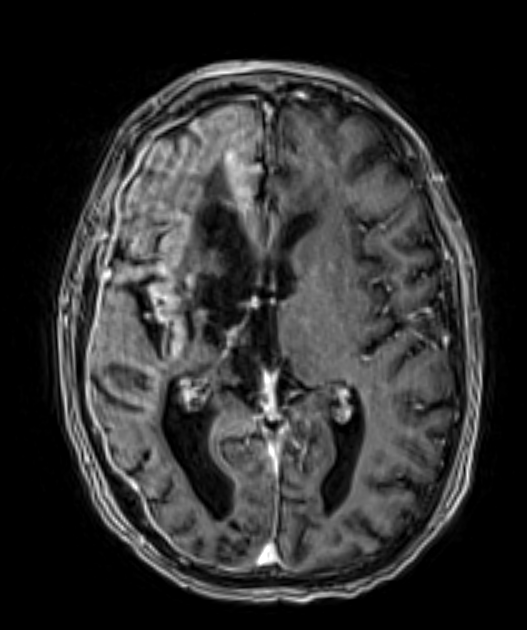
- 50-year-old patient with a history of primary CNS lymphoma 20 years ago that was treated with cranial irradiation.
- The patient presented with headache, confusion and left sided weakness.
- MRI showed subtle increase in T2-weighted hyperintensity in the right frontal cortex and gyriform enhancement.
- CSF analysis did not show any evidence of disease recurrence and imaging 1 year later showed partial resolution of the gyral enhancement.

- A 30-year-old patient with a history of a medulloblastoma treated in early childhood with surgical resection, and chemoradiotherapy.
- The patient presented with visual disturbance, headache, and seizures.
- MRI showed left temporo-occipital cortical T2-hyperintensity, mottled enhancement and foci of diffusion restriction.
- The patient was given steroids and, after 1 month, the enhancement had almost entirely resolved.
Treatment
- Supportive; episodes are typically self-limiting. The transient gyriform enhancement and swelling within a prior radiation field, with recovery, distinguishes it from tumour recurrence
Differential diagnosis
| Differential Diagnosis | Distinguishing Feature |
|---|---|
| Stroke / infarction | Persistent DWI restriction confined to an arterial vascular territory; no resolution on follow-up; no associated gyral enhancement |
| Radiation necrosis | Progressive enhancing mass with surrounding oedema and mass effect; elevated choline on MR spectroscopy; no spontaneous resolution |
| Tumour recurrence | Progressive enhancing lesion with elevated rCBV and choline on advanced MRI; no spontaneous resolution |
| Posterior reversible encephalopathy syndrome (PRES) | Posterior-predominant bilateral vasogenic oedema on T2/FLAIR; elevated ADC; no gyral enhancement in the radiation field |
| Encephalitis | Mesiotemporal or bilateral cortical T2/FLAIR hyperintensity with DWI restriction; enhancement; not confined to radiation field |
| Seizure-related cortical changes (Todd's) | Transient cortical FLAIR hyperintensity and swelling; resolves rapidly; DWI changes limited to cortex |
-
Armstrong et al. SMART syndrome (stroke-like migraine attacks after radiation therapy) in adult and pediatric patients. 2014. Journal of child neurology - Open in new tab. ↩